
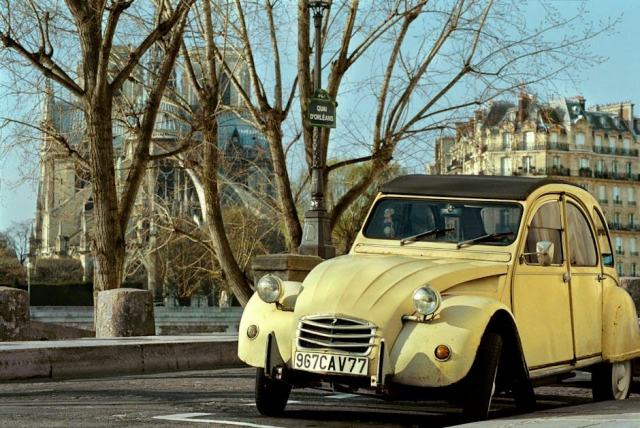
Convertible car rental in Paris is the hire of an open top car, a cabriolet in French, from an airport desk at Charles de Gaulle or Orly or from a city branch, usually in the premium or luxury tier rather than the standard fleet. The models are ordinary rental stock, a Mini, a BMW or a Mercedes. What changes is the category code you book, the price per day, the deposit held on the driver credit card, the boot space once the roof is stowed and the number of days a year in France when the roof is worth opening.
Booking an open top car in Paris, the short version
- A convertible is identified by the letter T in the second position of the four letter category code, so CTAR reads compact convertible, automatic, air conditioned, and that code is what the rental company guarantees rather than the photograph.
- Open top cars sit in the premium and luxury tiers of most Paris fleets, which raises the minimum age, the deposit held on the credit card and the insurance excess well above a compact saloon.
- The roof costs boot volume even when it is up, and a good deal more once it folds away, so soft bags travel better than hard suitcases on this booking.
- Paris itself is the least rewarding place to drive one: a 30 km/h limit, a low emission zone and paid surface parking. The roof earns its money on the departmental roads out of the city.
What convertible car rental means inside a booking system
Every rental car in Europe carries a four letter code, and it is the only part of a booking that the rental company contractually owes you, whether you book a compact hatchback or a car from the premium and luxury range in Paris. The photograph on the page is illustrative; the code is not. Reading it takes ten seconds and it removes most of the surprises at the desk.
| Position | What it describes | Values that matter for an open top car |
|---|---|---|
| 1 | Category | C compact, I intermediate, S standard, P premium, L luxury. Most Paris cabriolets are P or L. |
| 2 | Body type | T means convertible. F is an SUV, D a four or five door saloon. If the second letter is not a T, the car has a fixed roof. |
| 3 | Transmission | A automatic, M manual. Nearly every premium convertible in France is automatic. |
| 4 | Fuel and air conditioning | R covers an unspecified fuel with air conditioning, D a diesel with air conditioning, E an electric vehicle. |
So a car offered as CTAR is a compact convertible with an automatic gearbox and air conditioning, and a PTAR is the same thing a tier or two higher up the fleet. Air conditioning is not a contradiction in an open top car: it is what makes the vehicle usable on the motorway with the roof closed, and on a hot afternoon in traffic it is the reason the roof goes back up.
Which convertible models the Paris fleets actually hold
The open top stock in Paris is thinner than the brochures suggest. Standard rental companies often carry one or two cars in this body type at a given branch, and the specialist luxury operators hold the rest, which is why the answer to where to rent a convertible car in Paris depends less on the brand you want than on who has one free on your dates. The recurring models are these:
- Mini Cooper Convertible, the easiest of the group to place in a Paris parking space and the one most often available in the compact tier.
- BMW 4 Series Convertible, the common premium choice, comfortable enough to cross France on a motorway with the roof up.
- Volkswagen T-Roc Cabriolet and similar open top crossovers, which give a higher driving position than a classic cabriolet.
- Audi A3 or A5 Cabriolet, the usual alternative to the BMW in the same tier.
- Mercedes C-Class or E-Class Cabriolet, four seats and the most comfortable of the group over a long distance.
- Porsche 718 Boxster or 911 Cabriolet, in the luxury tier only, with a deposit and an age requirement to match.
Roadster or cabriolet
The trade press uses the two words loosely and the rental companies use them precisely. A roadster is a strict two seater, the Boxster and the Z4 being the popular examples, and its boot is the only luggage space on board. A cabriolet keeps a rear bench, usually a token one, which is why a four seat model from the same brand is the sane choice for two adults with bags: the rear seats become the shelf that the boot no longer is. If you are choosing between vehicles across a range of brands rather than between two body types, our premium and luxury fleet page covers the wider selection, and the same reasoning applies there.
Two consequences follow from a shallow fleet. The first is that a convertible booking is far more likely than a compact one to be substituted, which is exactly why the category code matters more than the model name. The second is that lead time changes everything: between May and September the open top cars go first, and a booking made a fortnight ahead often finds the tier empty on the dates that matter.
What sets the price of an open top rental
The price of a convertible is built from the same components as any other rental car in Paris, but three of them weigh far more on this body type, and none of them appears in the headline rate that a search page shows first.
The season. Between May and September the demand and the daily rate rise together, and the cheap dates are exactly the ones on which the roof stays shut. A booking made for late April or for the second half of September often finds the same car at an economy tier price with a fair share of usable afternoons. The tier. The gap between a compact cabrio and a sports roadster from a prestige brand is larger than the gap between an economy sedan and a full size estate, because the whole cost structure of the vehicle follows it: deposit, excess, mileage allowance and the price of a single panel. The extras. A second driver, an under twenty-five surcharge, a one way drop off and a reduced excess are each a separate line, and on this category they are proportionally heavier than on a standard car. Our page on what a Paris rental really costs takes the same list apart on the ordinary fleet.
Two habits protect the budget. Book in advance, because on a fleet this shallow the affordable options go first and the late booking is left with the luxury tier or with nothing at all. Then compare the total for the exact dates rather than the day rate, since a weekend rate and a weekly rate are built differently, and read the mileage allowance before the deals page: an itinerary to the south of France and back will pass any capped allowance, and the excess kilometre charge undoes whatever the offer saved.
Collecting an open top car: airport desk or city branch
Paris offers two ways to start, and for this body type they are not equivalent.
The airport desks
Charles de Gaulle and Orly hold the deepest fleets in the region, and the premium counters at both airports are where the convertibles sit. Our guides to collecting a rental at Charles de Gaulle and to the desks at Orly set out the terminal by terminal detail. An airport pickup also spares you the first hour of city driving, which is the least pleasant hour of the trip in any car and a wasted one in this one. Against that, an airport surcharge applies and the rental clock starts on your arrival day even if the car sleeps in a car park that night. The full picture is in our comparison of the three Paris airports.
The city branches
Central agencies cluster around the main stations, near Gare du Nord and along the rue de Bercy, and in the western business districts. These locations are a local rental service rather than a fleet hub. They save the surcharge and let you collect on the morning you actually leave, which is the argument developed in our guide to car rental in Paris city centre. The catch for a cabriolet is stock: a branch that holds forty cars may hold one convertible, and Sunday closing is the rule rather than the exception.
Questions people ask before booking a convertible in Paris
What is the minimum age to rent a convertible in Paris?
Twenty-one is the usual floor for the ordinary fleet, but convertibles sit in premium and luxury categories where the rental company commonly requires twenty-five, and thirty on the sports models. A young driver surcharge applies on top for anyone under twenty-five, charged per day, and the licence generally has to have been held for one to three years depending on the category.
Do I need a credit card to rent a convertible?
Yes, in practice. The deposit on an open top car is held on a credit card in the main driver's name, embossed and with enough available balance, and debit cards are refused on most premium categories. This is the single most common reason a booking collapses at the counter, and no amount of prepayment online replaces it.
Can I take the roof down while driving?
On most current models, yes, below a low speed threshold that the manufacturer sets, commonly somewhere between 30 and 50 km/h, and the handbook in the glovebox gives the exact figure for your car. Older mechanisms require the car to be stationary. Either way, the sequence takes fifteen to twenty seconds and it is worth rehearsing once in the car park rather than at a junction.
Is a convertible practical for luggage?
Less than the equivalent saloon, and much less once the roof is folded, because the mechanism occupies the upper part of the boot. Two people with soft bags travel comfortably. Four people with hard suitcases do not, and that booking belongs in a different body type.
Is the car insured when the roof is open?
The rental contract covers the vehicle in its normal use, and an open roof is normal use. What is not covered is what leaves the cabin: personal effects are excluded from the collision damage waiver, and an unattended car with the roof down is treated by every insurer as an invitation.
Can I return a convertible to a different city?
One way rentals exist on this body type but the fee is heavier than on standard cars, because the fleet is small and the vehicle has to come back to the branch that owns it. On the luxury tier some operators refuse one way returns altogether, so the question belongs in the booking rather than at the desk.
What the roof changes, day to day
The difference between a convertible and any other rental car is not the driving, it is the handful of small operations that surround it. None of them is difficult, and all of them are easier to learn before you need them.
- At the desk, ask the agent to open and close the roof once in front of you, and note the speed threshold, the position of the switch and whether the boot cover has to be latched first.
- Check the state of the fabric or the glass on the condition report. A soft top marks easily, and a scuff nobody wrote down at pickup becomes yours at return.
- Fit the wind deflector if the car has one. On a motorway it is the difference between a conversation and a shout, and it lives in the boot rather than on the car.
- Before parking anywhere, close the roof, whatever the weather and however short the errand.
- At the end of the trip, put the roof up before you reach the return lane. Agents inspect a closed car, and a wet cabin is a discussion you do not want at six in the morning.
Soft top or folding hard top
Both circulate in the Paris fleets. A fabric roof is lighter, folds into less space and is the norm on the current premium models. A retractable hard top is quieter at motorway speed and more resistant to a blade, but it swallows most of the boot when it is stowed. Neither is better; they simply fail differently, and the rental company will not let you choose between them anyway, since the guarantee is on the category code and not on the mechanism.
Deposit, excess and the cost of a torn roof
A convertible is rented on the same contract as any other car and priced on a different risk. The deposit blocked on the card is larger, the collision damage waiver leaves a higher excess, and the roof is a component that a standard waiver often treats as bodywork rather than as glass. Our explanation of how the excess works on a French rental applies here in full, and our guide to rental insurance in France covers what a third party policy does and does not replace.
Two points are specific to this body type. A cut or scorched fabric roof is expensive out of proportion to its size, which is a strong argument for reducing the excess to zero on a car you will park in the street. And a soft top offers no resistance at all to someone who wants what is inside, so the rule about leaving nothing visible, which is prudent advice on a saloon, is not optional here.
Driving a cabriolet inside Paris
Honesty is worth more than enthusiasm on this point: Paris is a poor city for an open top car. The general speed limit within the city is 30 km/h, so the pleasure of the engine never arrives. The whole agglomeration inside the A86 is a low emission zone, and the Crit'Air disc has to be on the windscreen from the first metre; our guide to the Crit'Air sticker and the low emission zone explains which vehicles are affected and how a rental car is normally already equipped.
Parking is the second obstacle. Surface parking is paid across every arrondissement and expensive in the central ones, and an open top car left at a meter is a car nobody should leave anything in. The practical answer is an underground car park, where the low roofline of a cabriolet is for once an advantage, and our guide to parking in Paris lists the zones and tariffs. The rest of the city driving advice, from the priority rules to the bus lanes, is in our notes on driving in Paris.
The routes that justify the roof
The car earns its rental rate outside the city, on the departmental roads where the traffic is light and the scenery is the point of the drive.
North and west
The D roads across the Vexin plateau begin less than an hour from the ring road and run through open farmland with almost no lorry traffic. Further out, the Route des Fruits along the Seine and the coast road beyond are covered in our Normandy road trip itinerary, which is the shortest way from Paris to a genuine open top drive.
South and east
The Loire valley gives long flat roads between chateaux, described in our Loire valley driving guide, and the vineyard lanes east of the city appear in our Champagne route. For a longer trip, the descent towards the Mediterranean in our Paris to the south of France itinerary mixes motorway with roof up and coastal roads with roof down; the motorway share is where the toll costs accumulate, and the speed limits by road type are worth reading before the first day.
How a convertible compares with the alternatives
Two other body types come up in the same search, and the trade is clear enough to set out side by side.
| Criterion | Convertible | SUV | Compact saloon |
|---|---|---|---|
| Luggage for four | No | Yes | Usually |
| Availability in Paris | Thin, book early | Wide | Widest |
| Deposit and excess | High | Medium to high | Low |
| Underground car parks | Easy, the car is low | Height limits bite | Easy |
| Reason to choose it | The drive itself | Space and comfort | Cost per day |
Where the trip is a family one, our guide to SUV rental in France and our comparison of seven and nine seat vans answer the same question with a different vehicle. If what you want is an easy drive rather than an open one, the automatic gearbox is the variable that matters, and it is treated in our guide to renting an automatic in France and in our comparison of the two transmissions. A quiet compromise exists too: the electric vehicles in the Paris fleets deliver a different kind of open road silence.
Season, weather and the number of usable days
Demand for this body type is concentrated between May and September and collapses outside it, which sets both the price and the availability. Paris records measurable rain on the order of one day in three across the year, spread fairly evenly, so even in July an itinerary built entirely around an open roof will meet a closed one. The practical planning rule is to treat the roof as a bonus on two days out of three rather than as the purpose of the trip.
Early morning is the best time of day for it. The air is cool, the departmental roads are empty, and the sun is low enough to be pleasant rather than punishing. By mid afternoon in August the cabin of a stationary convertible is hotter than a closed car, which is when the air conditioning in the fourth letter of the category code stops being a detail.
What to carry
Sun exposure in an open car is higher than most drivers expect, and a long day on a motorway with the roof down produces a burn that a windscreen would have prevented. Sunglasses, a hat that will not leave with the wind, sunscreen and a light layer for the evening cover almost everything. Anything loose on the rear seats, from a map to a jacket, leaves the car at the first serious acceleration.
Making the reservation
Renting a convertible is no harder than renting anything else once you know what you are looking for. Set the pick up location and the drop off location first, then the dates and the hours, because on a thin fleet the hour of collection decides whether a car in this body type exists at all. Filter on the body type rather than on the model, and read the category code that comes back. Where the operator is a specialist rather than a broker, the reservation often runs as a request that a human confirms within the day, and the confirmation is where the conditions of the contract appear in full: deposit, mileage, second driver, fuel policy, geographic limits.
Check availability again a week before departure if the booking is a request rather than a confirmed reservation, and keep the written confirmation on the phone: it is what customer service works from if the car on the forecourt is not the one you booked. Two details are worth a message to the agency before you reserve. Ask whether the vehicle offered is a soft top or a folding hard top if that matters to you, since the selection page rarely says. And if you are flying in, give the flight number at the contact stage: the airport desks track delayed arrivals, and a car held for two extra hours costs nothing while a no show costs the booking. Staff at the CDG and Orly counters work in English as a matter of course, so an international customer does not need a word of French to complete the process.
Before you confirm the booking
The checks below take a couple of minutes and prevent the failures that actually happen on this category.
- Read the category code and confirm the second letter is a T. A page titled convertible sometimes offers a hard roofed coupe.
- Check the minimum age and the licence held duration for the tier, not for the rental company in general.
- Confirm the deposit amount and that your credit card can carry it alongside the hotels on the same trip.
- Look at the fuel policy: full to full is the honest one and it is standard in France, and our page on fuel stations and payment covers the return leg.
- Verify the licence rules for your country of issue in our guide to licence requirements in France, and if the trip crosses a border, the conditions in our cross border driving guide.
- If the budget is the constraint rather than the body type, our breakdown of real rental costs in Paris shows where a booking actually leaks money.
Booked with the season in mind and collected at an airport rather than in the centre, a convertible is one of the few rental choices where the vehicle changes the trip rather than simply serving it. The service you are buying is not transport out of Paris; it is the two hundred kilometres of departmental road that follow, and the roof is only the equipment that lets you notice them.