Manual or automatic in France is decided by three things, in this order: the restriction code on your driving licence, the price group an automatic transmission sits in, and the roads on your trip. A manual transmission car is the default of the French fleet and the cheaper booking; an automatic is a separate rental category, tightest at the Paris airport desks in summer. Check the code before you check the price; the rest is your route, your drivers and the time of year.
What this guide settles before the price does
- Code 78 on a driving licence means automatic transmission only: driving a manual car on it is an offence in France and voids the insurance on the rental vehicle.
- An automatic is a rental category of its own rather than an option, and availability matters as much as price: drivers from the United States, Canada or Australia should expect it to be a premium in France, not the default.
- Manual cars are cheaper and everywhere; an automatic saves a great deal of clutch work in Paris traffic and on rural roundabouts, which is where the first hours of driving get tiring and where most of the stress of a road trip sits.
- The clutch pedal, the brake and the accelerator keep the same order in a left hand drive car; only the hand doing the shifting changes.
- Every electric car and almost every hybrid is an automatic, and on a French booking that is often the least expensive route to two pedals.
The licence code that decides before price does
In the United Kingdom, Ireland and most of the European Union, a driving test taken in a car with two pedals produces a licence limited to two pedals. The limitation is not a note in a file, it is printed on the card as a harmonised code, and every police officer in France reads it the same way. If you hold that code, the comparison below is academic: you book an automatic car, and the only remaining questions are which group and how far ahead.
The consequence people underestimate is the insurance one. A rental agreement covers a driver who is legally entitled to drive the vehicle on public roads. Take a manual transmission car on a restricted licence and you are not that driver, so the damage waiver you paid for at the counter answers nothing. The documents a French desk actually inspects are listed under licence requirements for hiring in France, and what the cover reaches once something goes wrong is the subject of the excess and the damage waiver.
The point only becomes expensive after an accident. Nobody at the desk verifies which pedals you have driven before; the check happens when a claim is filed, and the file then shows the licence, the vehicle and the accident report side by side. A minor accident that would have cost the excess becomes a bill for the whole repair, and a serious accident becomes a personal liability, because the rules that matter here are the ones on the licence rather than the ones in the brochure. That single risk is why the restriction code, and not the price, is the first thing to check.
Where code 78 appears on a licence
On the credit card format used across Europe and in the United Kingdom, turn the licence over. The table on the back lists your categories, and column 12 carries the codes attached to each one. The figure 78 beside category B means the holder may drive only cars with two pedals. A licence issued outside Europe rarely carries an equivalent marking, which is why a visitor from North America who has only ever driven an automatic car is legally free to rent a manual in France and would be very unwise to do so. International driving permits repeat the categories of the home licence and add nothing on this point.
Shifting with the other hand, and what does not change
Drivers from the United Kingdom, Ireland, Australia, Japan or India face a change that looks larger than it is. At home the gear stick sits to the left of the seat and is worked with the left hand. In France it sits to the right. The clutch pedal, the brake pedal and the accelerator stay in exactly the same order, left to right, in a left hand drive car as in a right hand drive one. Nothing about the footwork is reversed.
What the first hour costs you is the reach, not the technique. The hand that used to find first gear now finds the door, and reverse is often in an unfamiliar corner of the gate, sometimes behind a collar you have to lift. Practising the pattern in the car park before joining traffic is worth five minutes. The genuinely demanding part of driving in France for a visitor is the road layout rather than the gearbox, and the junctions that catch visitors out are described in these Paris driving tips.
Drivers arriving from the United States, Canada or the Gulf face the opposite problem. Stick shift ownership there has fallen to the point where a driver's license holder may never have used a clutch pedal at all. Learning on a hire car, in a foreign city, on the second day of a trip, is a poor plan whatever the saving.
The vocabulary trap when you compare offers across countries
Half the confusion in travel forum threads comes from the words themselves. In the United States a manual transmission car is a standard, and in casual speech an auto is the automatic. In Britain and Australia the same car is a manual and the driver talks about a stick shift only as an Americanism. A French rental site written in English uses manual and automatic and nothing else, so a visitor searching for a standard finds nothing and concludes the category does not exist. The forum posts that answer them are usually right about the driving and vague about the booking, which is where the money actually moves.
The wider picture explains why the question comes up at all. Manual transmissions remain the norm across Europe, much of Asia, the Middle East and South America, while the USA, Canada and Australia have gone almost entirely automatic. Visitors from the second group arrive expecting the second pedal layout to be standard and find that in France it is a premium. Visitors from the first group are surprised there is a debate. Neither is wrong about their own countries; both are looking at a fleet built for local buyers rather than for travel.
The same trap works on the spelling of the document. American guidance says driver's license, European rental companies write driving licence, and the two mean the identical thing on a French counter. What matters is not the word but the category and the codes printed beside it. Read the transmission from the ACRISS code on the confirmation rather than from the marketing name of the car, and the ambiguity disappears in one glance.
What driving a manual car actually asks of you, minute by minute
The mechanics are the same everywhere: press the clutch, select the gear, release the clutch through the biting point while the accelerator comes in. What changes in France is how often you do it. On a rural departmental road with a village every four kilometres, a fifty kilometre per hour limit at each entry sign and a roundabout at each exit, the sequence repeats several times a minute for the whole day.
None of that is difficult for a habitual driver, and it is why a manual is a perfectly sensible booking for most European visitors. It is a different proposition for someone whose driving experience with a clutch stops at a lesson twenty years ago. Stalling at a busy junction is a safety issue rather than an embarrassment, and the mental load it adds sits on top of unfamiliar signs, an unfamiliar side of the road and a phone on the dashboard reading out a map. The automatic buys that attention back, which is the honest argument for it: not comfort, but the stress you are not carrying on day one.
How the two feel after a few hours is the part no specification sheet shows. With a manual you stay involved, you read the road further ahead because you are choosing the gear for the next bend, and shifting becomes automatic in the other sense of the word. With two pedals your hands stay on the wheel and your eyes stay on the signs, which is easier when every destination is new and the junction layout is not the one you learned on. Neither is safer in itself. What differs is where your attention goes, and on a first driving experience in France that is not a small thing.
Where a manual asks more of you on French roads
Motorway driving is the easy case. Once you are on an autoroute at a steady speed the gearbox is irrelevant, and a run from Paris to the Mediterranean is four hours in top gear with three stops. If your itinerary is mostly of that kind, the gearbox will barely register.
Roundabouts and priority from the right
France is generally credited with more roundabouts than any other country, counted in the tens of thousands, and rural departmental roads string them together every few kilometres. Each one is a downshift on approach, a hold in second while you read the traffic, and an upshift on the exit. On a day covering three hundred kilometres of secondary roads, that is a great deal of clutch work. In towns and villages you also meet priorite a droite, the rule that gives way to traffic entering from an unmarked side road, and it forces the same cycle at junctions where nothing appears to be happening.
Hill starts, toll booths and the handbrake
The classic uncomfortable moment is a stop on a slope with a queue behind. It happens at toll plazas, at the barrier of an underground car park, and on the ramps of old town centres in Lyon or Marseille. Cars sold in France in the last decade almost all carry a hill hold function that keeps the brake applied for a second or two after you lift the pedal, which removes most of the difficulty, but you cannot rely on getting one. Which lanes at a peage let you keep rolling is set out in the French toll road guide, and the ramps in question turn up in parking in Paris.
What an automatic really costs on a French booking
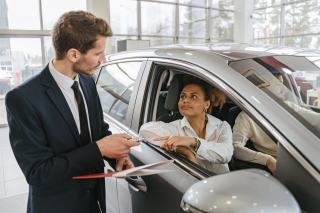
Rental fleets in France are still built around manual transmissions, and an automatic is booked as a distinct group rather than added to an existing reservation. That single fact explains most of what follows. The transmission is the third letter of the four in the ACRISS code printed on the confirmation, and reading that code then pinning the gearbox at the desk is the subject of renting an automatic car in France.
Because the automatic is a group of its own, it is priced by supply. In February a company car park has spare stock and the difference is modest. In July, on the Cote d Azur, the same booking is a scarce category and the gap widens. The way to control it is calendar rather than negotiation: book the automatic early, and treat a late booking as a manual booking. The levers that genuinely move a total are listed under cheap car hire in the capital.
Where you pick the car up matters as much as when. Rental companies concentrate their automatic cars at the airport branches, because that is where the arrivals from countries with no manual tradition land, and thin them out in small town agencies. An airport collection therefore offers the better odds and the higher fees, since airport surcharges apply to every category; a city branch is cheaper and stocks fewer automatics. Renting for a fortnight rather than a week also changes the arithmetic, because the weekly rate flattens the daily difference. The comparison to run is not manual against automatic in the abstract but the two totals for your dates, at your desk, with the same insurance line on both, and what an airport surcharge actually covers is broken down in Paris airport car hire.
| Criterion | Manual | Automatic |
|---|---|---|
| Licence | Requires an unrestricted category B | Open to every category B holder |
| Position in the price grid | The reference group | One or two groups higher |
| Late availability | Almost always something on the forecourt | First category to sell out in summer |
| Choice of engine and body | The whole fleet, diesel included | Narrower, and skewed to petrol, hybrid and electric |
| City traffic | Constant clutch work in stop and start | One less thing to manage at every junction |
| Motorway cruising | No practical difference | No practical difference |
| Long mountain descent | Direct control of engine braking | Needs the manual or sport mode to do the same |
One belief deserves retiring. Automatic transmissions used to cost fuel, and on a torque converter of the nineteen nineties they did. A current gearbox with seven, eight or nine ratios keeps the engine in its efficient band better than most drivers manage, and on the official test cycle the two versions of the same model are usually level. The cheapest combination on a French forecourt remains a small diesel with a manual gearbox, but that is a matter of category pricing and fuel cost rather than consumption, and what you will actually pay at the pump belongs to the French fuel station guide.
Not all automatic cars drive alike
Rental listings say automatic and stop there, which hides a real difference in behaviour. Three families circulate in the French fleet, and knowing which one you have changes what to expect in the first hundred metres.
The torque converter is the traditional design and the smoothest at walking pace. It creeps forward gently when you lift the brake, which is exactly what you want in a queue or on a ramp. The EAT8 fitted to many Peugeot and Citroen models is of this type. The dual clutch gearbox, sold as DSG by the Volkswagen group and as EDC by Renault, shifts faster and uses less fuel, but it holds a clutch open at very low speed and can hesitate for a beat when you pull away uphill. Nothing is wrong with the car. It simply asks you to be a little more deliberate with the accelerator. The third family, the automated single clutch, converts an ordinary manual gearbox with an actuator and nods the car at every change; it has largely left new fleets, and if a very cheap automatic feels jerky, that is usually what you have.
The one road where a manual still has the edge
On a long alpine or Pyrenean descent, holding a low gear lets the engine do the braking and keeps the discs cool, which matters more on a loaded car than most visitors expect. A manual gives that control directly. Almost every automatic sold in the last fifteen years can do the same through a sport position or paddles behind the wheel, but you have to know they are there and use them, whereas riding the brake pedal for eight kilometres of hairpins is the natural thing to do and the wrong one. If your route south from Paris takes in real mountain roads, this is worth a minute of thought whichever gearbox you book.
Electric and hybrid cars answer the question by default
An electric car has a single reduction gear and no clutch at all, and almost every full hybrid drives as an automatic. On a French booking this is frequently the least expensive way to get two pedals, because the electric groups are priced against each other rather than against the manual fleet, and because a rental company with charging on site would rather move those cars than leave them parked. They also carry a Crit Air 1 or zero emission sticker, which matters inside the low emission zones covered by the Crit Air sticker rules. The trade is range planning, worked through in hiring an electric vehicle in France.
- Is it hard to rent a manual car in France?
- No, it is the default. The rental fleet in France is built around manual transmissions, so the manual version of a given group is the reference price and the one still available at short notice. The difficulty runs the other way: it is the automatic that has to be reserved early in the summer months.
- Can I drive a manual in France on an automatic only licence?
- No. Code 78 next to category B restricts you to automatic transmission, and driving a manual on that licence is an offence in France as it is at home. It also puts you outside the rental agreement, so the damage waiver you paid for would not answer for a claim.
- Do the pedals change position in a left hand drive car?
- No. The clutch, the brake and the accelerator keep the same order from left to right whichever side the steering wheel is on. Only the hand that works the gear stick changes, and the reach to the controls on the door and the stalks takes a few minutes to learn.
- Why is an automatic more expensive to hire in France?
- There is no fixed supplement, because the automatic is a separate rental category rather than an option. It sits one or two groups higher in the price grid, and the real gap depends on the season and the location, narrowing out of season and widening on the coast in July and August.
- Will I be given a manual if I booked an automatic?
- You reserved a category, not a specific model, and the transmission is part of the category rather than the model. Read the third of the four letters in the ACRISS code before you leave the desk, and say so at the counter if the keys handed over do not match it.
- Is a manual better for mountain roads in France?
- It gives more direct control of engine braking on a long descent, which keeps the brakes cool on passes in the Alps and the Pyrenees. An automatic does the same through its sport position or its paddles, so the advantage is a matter of habit rather than capability.
Deciding in five questions
Run through these in order and the answer usually appears before the last one.
- Does your licence carry code 78, or has any driver on the booking only ever driven an automatic car? If yes, stop here and book two pedals.
- How much of the trip is city driving? Two days in Paris and a week on the coast is a different proposition from an airport collection followed by a straight motorway run.
- When are you travelling? An automatic reserved in March for August is a modest difference; the same request made in late July is whatever is left on the forecourt.
- Who else is driving? A second driver who has not used a clutch pedal for ten years turns a shared drive into a single one.
- Is the price gap material against the rest of the budget? Compare it with a night of accommodation before deciding, and check the insurance options at the same time, since that is where the larger sums usually sit.
For most visitors who drive manual at home, renting a manual in France is straightforward and cheaper, and the roundabouts are a nuisance rather than an obstacle. For anyone who does not drive one weekly, the automatic buys back attention that is better spent on the road signs, and that is the real return. The major rental companies all offer both, at every major airport and in the city branches, so the decision is yours rather than theirs. Whichever you choose, book the car against a category you have read rather than a photograph, take the route from the French navigation guide, and confirm the gearbox at the counter rather than in the car park.