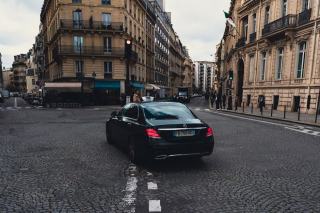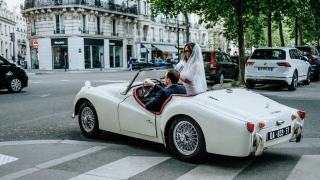
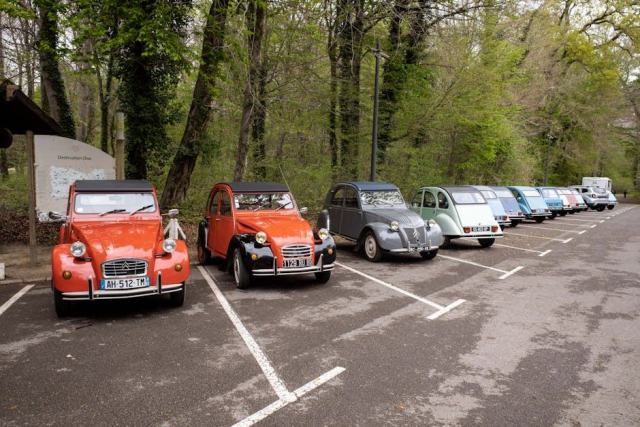
Parking in Paris comes down to three: a metered bay in the rue itself, an underground car park, or a park and ride beyond the ring road. On-street parking costs around 6 euros for 1 hour in the city centre, is capped at six hours and free at night. A car park keeps a rental car all day for the price of two or three.
What to know before you park
- Street parking is charged 9am to 8pm from Monday to Saturday, and free parking applies at night, on Sundays and on public holidays.
- Car parks in Paris sit under most squares, from the Hotel de Ville and the Louvre to Saint-Lazare, Notre-Dame and the Champs-Elysees, and booking online guarantees the space.
- Height in a parking garage rarely exceeds 1.80 metres, which rules out a van, a roof box and most nine seat vehicles.
- Since October 2024 the tariff at the kerb is tripled for heavy vehicles, an SUV included.
- Park and ride sites at Porte Maillot, Saint-Ouen and the other gates of the city hold a car for a few euros a day.
What parking in Paris actually costs
The city sets one tariff for its residents and another, much higher, for everyone else. A rental car always falls in the second category. Two zones divide the map: the central zone covers the first to the eleventh arrondissement, the outer zone the twelfth to the twentieth, and the difference between the two runs to about a third of the hourly price. The meter column, which the city calls a horodateur, prints the tariff in force on its face, and it is the only figure that counts on the day you park.
What surprises most visitors is not the hourly rate but its shape. The first two hours are charged at the flat rate. Beyond that the price rises far faster than the clock, so a six hour stay on the same bay costs several times what six separate first hours would have cost. The design is deliberate: the kerb is meant for short stops, and the city pushes anything longer underground or out of town. Once you know that curve, the decision almost makes itself, and it is the single most useful thing to understand about parking in Paris.
Payment is cashless. The horodateurs take a bank card, and the PayByPhone app covers the whole city from a phone, which is the practical choice when you are already walking away from the car. Both ask for the same two pieces of information: the licence plate and the zone number printed on the nearest column. Enter the plate exactly as it appears on the registration document of the hire car, because enforcement scans plates and a single wrong character reads as an unpaid bay.
Free hours, and the days nobody pays
Charging runs from 9am to 8pm, Monday to Saturday. Outside those hours the same bay costs nothing, which means an overnight stop from Saturday evening to Monday morning can be free from end to end. Sundays and public holidays are free across the city. This is the one genuinely cheap way to leave a car in the centre, and it is why so many drivers arrive on a Saturday afternoon and pay for two hours rather than a whole weekend.
Two warnings go with it. A free bay is still a legal bay, so the marking on the ground and the sign on the post still apply, and a delivery bay or a bus lane remains forbidden at every hour unless a panel says otherwise. And free does not mean unlimited: the six hour cap belongs to the paid period, but a car left for several days in the same spot will attract attention from enforcement whatever the day of the week.
Underground car parks, the default answer for a hire car
Covered car parks are the reason parking in Paris is manageable at all. Indigo, Saemes, Q-Park, EFFIA and Interparking run several hundred sites between them, most of them under a square, a station or a hospital, and they are open around the clock. A full day sits in the same range as two or three hours at a meter, and a monthly or weekly package brings the daily figure down further. For a rental car the calculation is rarely close.
They also solve a problem the kerb does not. A hire car carries luggage, a satnav bracket and sometimes a child seat, and a locked, lit, camera-covered level under a square is a different proposition from a bay on the rue de Rivoli at two in the morning. If you are collecting the vehicle in town rather than at an airport, the desk staff at a city centre pickup point will usually name the car park they use themselves.
Two constraints deserve a look before you drive down the ramp. The first is height: most Paris car parks accept vehicles up to about 1.80 metres, a few reach 1.90, and very few go beyond. A roof box, a bike rack or a nine seat van will not fit under most of the city, and the sign at the entrance is not negotiable. The second is width, since older sites were built for the cars of the nineteen seventies and their bays and ramps show it.
Booking a space in advance
Every operator sells online, and the booking platforms, Onepark, Zenpark and Parclick among them, aggregate several operators on one map. A reservation does two things: it guarantees a space at a car park that fills up, near a station on a Friday evening for instance, and it usually costs less than the drive-in rate for the same duration. The confirmation carries a QR code or a plate reading, and you keep it on the phone rather than printing it.
- Book ahead for a Saturday in the Marais, around Notre-Dame or near the Champs-Elysees, where the demand is constant.
- Check the closing time: a handful of small car parks still shut overnight, and the barrier will not lift.
- Read the height and the maximum stay in the conditions of the booking, not on the map.
The four ways to leave a car, compared
| Option | Typical cost | Best for | Watch out for |
|---|---|---|---|
| On-street bay | 4 to 6 euros the first hour, far more beyond two | A stop of an hour or two, or a free night | Six hour cap, heavy vehicle surcharge |
| Underground car park | Roughly 25 to 45 euros for 24 hours in the centre | A full day, a night, luggage in the boot | Height limit near 1.80 metres |
| Park and ride | A few euros a day, less with a transport pass | Several days without the car | Sited outside the city, so plan the metro leg |
| Hotel parking | Often 25 to 50 euros a night | Arriving late with bags | Spaces are few, so contact the hotel first |
The table hides one thing worth saying plainly: the cheapest option in the city centre is almost never the kerb. It is either a car park bought for the day, or no car at all for the hours you are walking around.
Park and ride on the edge of the city
The park and ride sites, signposted as parcs relais, sit at the ends of the metro and RER lines on the outskirts of Paris and are run under the regional transport authority. You leave the car at a station beyond the ring road and finish the journey by train, usually in fifteen or twenty minutes. A day costs a few euros, and holders of a valid travel pass often pay less or nothing at all. For a stay of three or four days without the car, this is the cheapest arrangement that exists.
Names to look for are the terminus stations on each line, and the gates of the city that give them their names: Porte de Vincennes, Porte de Versailles, Porte Maillot, Saint-Denis and Saint-Ouen to the north, Bobigny and Creteil to the east and south. The catch is simple and it is the reverse of the city centre: the car is twenty minutes away, so a spontaneous drive to the coast on the second morning means twenty minutes of metro before you even start the engine.
Where to park near the sights people actually visit
Almost every monument in the city has a car park within a few minutes on foot, and knowing which one saves a lap of the block. Near the Louvre and the Hotel de Ville, the car parks under the square and along the quays absorb most of the demand. Around Notre-Dame the sites on the Ile de la Cite and the left bank quays are the obvious pair. For the Champs-Elysees and the Arc de Triomphe, the car parks under the avenue itself are the least painful answer, and for the Eiffel Tower the ones on the quai Branly side.
Stations follow the same pattern. Gare du Nord, Gare de Lyon and Gare Saint-Lazare all have parking underneath or immediately alongside, priced for short stops and expensive by the day. Saint-Germain-des-Pres, Montparnasse and the Stade de France to the north are all served the same way. Whatever the address, the useful habit is to search the car park before setting off rather than the monument, because the last two hundred metres in central Paris are where the time goes.
- Enter the car park name into the satnav, not the monument, so the route ends at the ramp.
- Note the exit you will use on foot: large car parks have four or five, and they surface streets apart.
- Photograph the level and the bay number before you walk away.
A word on the approach itself. Traffic in the centre rewards patience and punishes improvisation, and a wrong turn onto a bus lane is a fine in its own right. The habits that make driving in Paris survivable apply doubly in the last few streets, when the temptation to stop on a corner is strongest.
Car parks by neighbourhood
North of the river, the underground sites along the boulevard Haussmann serve the department stores and the Opera quarter, and Montmartre is reached from the parking garages at the foot of the hill rather than from the top, since the lanes above are narrow and mostly one way. Bastille has a large car park under the square itself, Bercy another beside the park, and the Palais Royal one of the oldest in the capital, a few steps from the Louvre and its museum entrances. On the Ile de la Cite, the site under the parvis puts you a minute from Notre-Dame.
South of the Seine, Montparnasse, Saint-Michel and the avenue running down to the Invalides all have parking nearby, and the mairie of each arrondissement is a reliable landmark, since a public car park is often attached to it. The pattern holds across town: look for the square, the station or the town hall, and the parking is usually underneath.
Charging an electric hire car while it is parked
Most large car parks in Paris now fit charging points on at least one level, and the operators list them on their own map before you book. Charging is billed by the kilowatt hour on top of the parking fee, and the mobile apps of the charging networks handle payment, so an account created before arrival saves a queue at the terminal. On-street charging exists as well, run by the Belib network across Ile-de-France, with bays reserved for vehicles actually plugged in.
Two practical points for a hire car. Check which cable travels in the boot, since a vehicle delivered with a type 2 cable can use almost every public point while one without it is limited to terminals carrying their own. And read the time restrictions on the bay: a charging space is usually capped at a few hours, and leaving a fully charged vehicle there attracts a penalty of its own. Our guide to renting an electric vehicle in France covers ranges and connectors in more detail.
Heavy vehicles, SUVs and the surcharge
Since October 2024 the city has charged a tripled visitor tariff for heavy vehicles on the street: combustion and hybrid cars from about 1.6 tonnes, and electric cars from about 2 tonnes. The first hour in the central zone lands near 18 euros rather than 6. It applies to the kerb only, not to the underground car parks, which is a second reason to go underground with a large vehicle.
The threshold catches more cars than people expect. A large family SUV, a seven seat estate, a fully equipped electric saloon: all of them can cross it. The kerbside weight appears on the registration document in the car, and the rental company can confirm it at the desk. If you have booked an SUV from the Paris fleet, treat street parking as the expensive option and price a car park for the day instead.
One thing the surcharge does not do is restrict access. That is the job of the low emission zone, which works on the age and the engine of the vehicle rather than its weight, and which applies across a wide area around the city on weekdays. A recent hire car sits in the cleanest categories, but the sticker still has to be on the windscreen, and our page on the Crit'Air sticker and the low emission zones sets out who orders it on a rental contract.
The parking FAQ for rental drivers
Is there free parking in Paris? Yes, at night between 8pm and 9am, all day on Sundays and on public holidays. The bays are the same metered bays used during the day, so the markings and the signs still apply, and a delivery bay or a bus lane remains forbidden around the clock.
How much does an hour of street parking cost? Around 6 euros in the first eleven arrondissements and around 4 in the outer ones, tripled for heavy vehicles since October 2024. The price for 1 hour is printed on the meter column, and the tariff beyond two hours rises much faster than the hourly figure suggests.
Can I park a rental car overnight in the street? You can, and between 8pm and 9am it costs nothing, but the six hour cap resumes at nine in the morning and the car has to be paid for or moved. For several consecutive nights, a car park or a park and ride site is both cheaper and safer.
Do I need to book parking in advance? Not usually, except around the busiest sights at the weekend and near stations on Friday evenings. Online booking through an operator or a comparison site guarantees the space and normally costs less than the drive-in rate.
What happens if I do not pay? You receive a post-parking charge, the FPS, which replaced the old parking fine in 2018. In Paris it is set at 75 euros in the central zone and 50 euros in the outer zone, with a reduced amount if payment reaches the city quickly, and the notice states both the sum and the deadline.
Will my rental company forward a parking notice? It will, and it will add an administrative fee for doing so. The notice follows the plate, so it reaches the hire company first, which identifies the driver and passes the charge on. Settling anything outstanding before you return the car is the cheaper route.
When it goes wrong: the FPS, the clamp and the pound
France abolished the parking fine in 2018 and replaced it with a post-parking charge set by each city. It is not a criminal penalty, which means it is not contested in the same way: the challenge goes first to the city, within a month, and only afterwards to a specialised commission. Keep the payment receipt or the app history, since a paid session wrongly recorded is the most common ground on which a charge is cancelled.
Towing is a different matter and a more expensive one. A vehicle left on a delivery bay, a pedestrian crossing, a bus lane or in front of a garage entrance marked sortie de garage can be removed to the pound, the fourriere. The removal charge alone runs to about 150 euros, a storage fee accrues for each day the car stays there, and the paperwork to recover a hire car with a rental agreement in a foreign name takes an afternoon at best. This is the scenario that makes a 35 euro car park look like a bargain.
The list of places never to leave a car is short and worth memorising: yellow kerb markings, zigzag lines, delivery bays, taxi ranks, bus lanes and stops, cycle lanes, pavements, and the marked entrance to any courtyard. None of them is ambiguous on the ground, and all of them are checked.
A parking routine that works in Paris
The travellers who find parking in Paris straightforward, and who avoid fines altogether, all do the same three things. They decide before leaving the hotel whether the car is needed that day, and if it is not, they leave it underground or beyond the ring road and take the train. They book the car park rather than hunting for a bay, which turns a twenty minute problem into a two minute one. And they treat the street tariff as what it is, a price for stopping briefly, not a price for staying.
The rest is detail that fits on a phone: the PayByPhone app installed before arrival, the plate saved in it, the zone number checked at the column, and a photograph of the bay. Do that and the city is easy to drive in for the parts of the trip where the car earns its keep, the day out to a chateau or the drive to the coast, which is where a hire car makes sense in the first place. If you are collecting the vehicle on arrival, the airport rental guide covers the desks, the shuttles and the first kilometres into town.